Pressure Washing vs. Power Washing: Is There Actually a Difference?
The technical difference is heat. Power washing uses heated water, while pressure washing uses cold water at a similar pressure. Heat helps with grease, oil and gum, so it earns its place on restaurant pads and commercial concrete. For most homes the two words mean the same thing, and the method that matters more is soft washing.
Where the two names came from
Both machines do the same basic job. A pump pushes water through a hose and out of a narrow tip at high pressure. A power washer adds a burner that heats the water on its way through. That is the whole difference in equipment terms.
In everyday use the words have blurred together. Companies use them interchangeably, homeowners search for one when they mean the other, and some businesses say power washing simply because it sounds tougher. Neither name tells you anything about the quality of the work or whether the right method will be used on your house.
So when you compare companies, ignore the label and ask about the method for each surface. That question tells you far more than the name on the truck.
There is a third term that matters more than either of them: soft washing. It uses similar equipment turned right down, closer to the flow of a garden hose, and relies on a cleaning solution to do the work. On a typical Florida home, most of the square footage that needs cleaning is walls, trim, eaves and screens, and that is soft washing territory, not pressure or power washing. If a company only talks about pressure, ask how they clean the walls.
What heat actually does
Hot water breaks down grease and oil the same way it does at the kitchen sink. Cold water tends to push grease around, while hot water helps it lift and rinse away. That is why heated equipment is common on restaurant dumpster pads, drive-thru lanes, fuel station aprons, fleet parking and heavy equipment. It also softens chewing gum on storefront sidewalks.
For businesses, that grease is a slip risk as well as a look problem, which we cover in why curb appeal matters for your business.
On a home driveway, heat is helpful but rarely essential. An oil stain under a car comes up mainly because of a degreaser that is applied and given time to work, as explained in how to remove oil stains from your driveway. And heat does very little against algae, mildew and the green film on a Florida driveway. Those are removed by chemistry and even cleaning, not by temperature.
Where neither is the right tool
Most of a house should not be pressure washed or power washed at all. Siding, stucco, painted trim, soffits, screens and window frames are cleaned by soft washing: a cleaning solution applied at low pressure, left to work, and rinsed off gently. High pressure, hot or cold, can strip paint, drive water behind siding, tear screens and break window seals.
Wood is the other surface where force does harm. High pressure raises the grain and leaves furring and gouges that show for years, and heat does not change that. The gentler approach is described in cleaning wood decks and fences without damaging them.
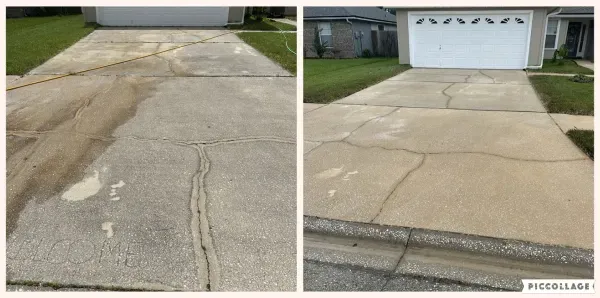
Concrete is where pressure belongs. Driveways, sidewalks and patios are cleaned with a flat surface cleaner that spreads even pressure across the slab, which avoids the striped look a handheld wand leaves behind. What a full visit looks like is laid out in what to expect on the day of your appointment.
Questions that get you the right method
Ask each company how they will clean each surface on your property. A good answer sounds like soft washing for the walls, eaves and screens, a surface cleaner for the concrete, and a degreaser for oil. A worrying answer is one method, full pressure, for everything.
If you run a restaurant or a business with grease or gum on the concrete, ask whether heated equipment will be used. If you own a home, ask how they protect plants, paint and screens. Those answers matter far more than whether the company calls itself a pressure washer or a power washer.
When you line up two or three quotes, compare them surface by surface. One company may include the walkways and patio while another quotes the driveway alone, and one may plan a degreaser for the oil spot while another plans to just blast it. A slightly higher quote that covers the right method on every surface is usually the better value.
If you are not sure what your property needs, request a quote or call (904) 506-7656 and we will walk you through the method for each surface before any work starts.
Frequently asked questions
Is power washing stronger than pressure washing?
Not necessarily. The pressure range is similar. The difference is that power washing heats the water, which mainly helps with grease and oil.
Do I need hot water to clean my driveway?
Usually not. Dirt, algae and mildew come off with the right pre-treatment and a surface cleaner using cold water. Oil stains respond mainly to a degreaser, with heat as a help rather than a requirement.
Can hot water damage surfaces?
Heat combined with high pressure does damage faster on the wrong surface, such as wood, painted finishes and some sealers and coatings. That is why heated equipment is used selectively rather than on everything.
Is soft washing a kind of pressure washing?
It uses similar equipment, but at very low pressure, closer to a garden hose. The cleaning is done by the solution rather than by force, which is why it is safe for siding, stucco and screens.
Related reading
Get a free quote
H2O Pressure Washing is based in Saint Johns and serves St. Johns County and nearby communities in Clay and Duval counties. For a free, fixed-price quote, tell us about your property or call (904) 506-7656.
