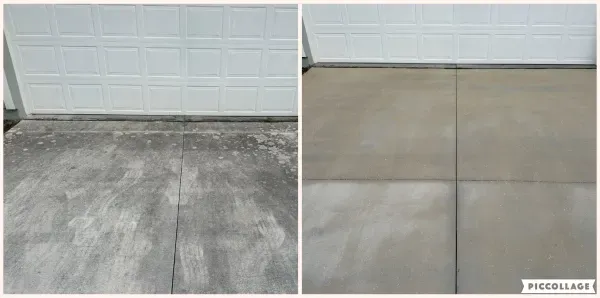
How to Remove Oil Stains From Your Driveway
Oil, transmission fluid and rust are the three stains that make people give up on their driveway. None of them are as permanent as they look.
Why oil is harder than dirt
Concrete is porous. Oil does not sit on top of it, it soaks in, and by the time you notice the stain it has migrated below the surface. That is why scrubbing the top does almost nothing, and why a pressure washer alone tends to clean the concrete around the stain and make it stand out more.
Heat makes it worse. A Florida driveway in August draws oil deeper into the slab.
Fresh spills: act immediately
If you catch it while it is still wet, you can prevent most of the problem yourself:
- Blot, do not wipe. Wiping spreads the spill and pushes it in.
- Cover it thickly with cat litter, sawdust or baking soda.
- Leave it to draw the oil out for several hours, ideally overnight.
- Sweep it up and repeat if the material comes away dark.
What you should not do is hose it immediately. Water drives oil deeper into the pores and spreads the stain outward.
Set in stains need degreasers, not force
Old oil needs a degreaser that breaks the bond and lifts the oil back out of the concrete, plus dwell time to work and hot water to help it along. Then the surface gets cleaned evenly with a flat surface machine so you are not left with a clean patch surrounded by dirty concrete.
Turning the pressure up instead is how driveways get etched. Once you have cut lines into the surface of the slab, those do not come out.
Rust is a completely different problem
Orange staining, usually in arcs across the driveway, is iron from well water irrigation rather than anything you spilled. It is a chemical bond between iron oxide and the concrete, and no amount of pressure or degreaser will touch it. It needs a dedicated rust remover, applied carefully and neutralised, because these products are acidic and will damage landscaping and etch concrete if used carelessly.
Removal is only half of it. If the sprinkler keeps hitting the same concrete, the stain returns within months. Adjust the head.
We handle oil, rust, tannin and hard water staining as part of our concrete cleaning. Free quotes at (904) 506-7656.
Be realistic about the result
Fresh stains usually come out completely. Stains that have been baking into a slab for several years often improve dramatically without returning to perfectly uniform concrete. Anyone who promises a five year old oil patch will vanish entirely is overselling.
We will tell you at the quote which category yours is in, rather than after you have paid.
Preventing the next one
- Fix the leak. A dripping vehicle will restain a cleaned driveway within weeks.
- Keep absorbent material in the garage so fresh spills get covered immediately.
- Consider sealing the concrete or pavers after cleaning, which slows absorption.
- Point irrigation at the lawn rather than the driveway.
- Oil soaks into porous concrete, so surface scrubbing does nothing.
- Blot and cover fresh spills. Do not hose them, which drives oil deeper.
- Rust from irrigation is a chemical bond and needs its own treatment.
- Old stains usually improve dramatically rather than disappearing entirely.
Frequently asked questions
Can old oil stains be fully removed?
Fresh ones usually come out completely. Stains that have sat for years generally improve a great deal but may not return to perfectly uniform concrete.
Will a pressure washer alone remove oil?
No. It cleans the concrete around the stain and often makes the stain more obvious. Oil needs a degreaser and dwell time.
What is the orange staining on my driveway?
Almost always iron from well water irrigation. It is rust and needs a dedicated rust remover rather than pressure or degreaser.
Should I seal my driveway after cleaning?
It is worth considering. Sealing slows how much the concrete absorbs, which makes future spills easier to deal with.
Is it safe for my grass?
Yes when done properly. Landscaping is pre wetted and protected, and rust removers are neutralised before rinsing.
Free quotes across St. Johns, Clay and Duval counties. Call (904) 506-7656 or request a quote online.
