Exterior Cleaning for St. Augustine Vacation Rentals
Short term rentals in St. Augustine and the beaches generally need exterior cleaning every 6 to 12 months, roughly twice the frequency of an owner occupied home, because salt air, constant guest traffic and photo driven bookings all raise the standard. Most owners schedule the full exterior before peak season and again after it, timed to a vacant day between reservations.
Guests judge the outside first
A guest forms an opinion of your rental before the door opens. They pull into the driveway, walk up the path, and look at the front of the house while someone finds the lockbox code. Green streaks on the siding, a black stained walkway or a fogged front window all register in those first seconds. Nothing inside undoes that impression completely. Reviews reflect it in language that sounds vague, words like tired or not as pictured, and vague reviews are the hardest kind to fix.
Listing photos are the other half of the problem. Most owners shoot their photos once, when the property is new to the platform and looks its best, then leave those images up for years. When the house arrives dirtier than the pictures, the gap between expectation and reality becomes the review. Guests are also photographing your property constantly for their own posts, and those images are public. Exterior condition is effectively part of your marketing whether you manage it or not.
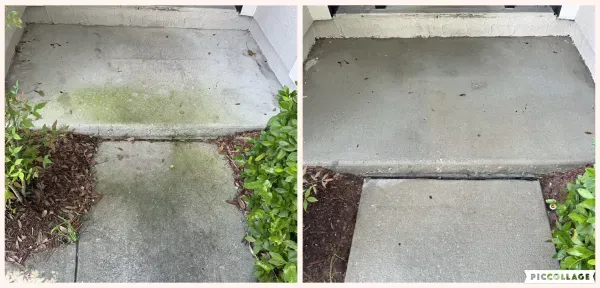
There is a practical angle too. A slick pool deck or a mossy walkway is a genuine hazard with unfamiliar guests and kids running around. Algae on concrete gets slippery well before it looks dirty, especially after the afternoon rain that shows up most summer days. Cleaning the walking surfaces is a safety item first and a cosmetic one second.
Small details carry more weight at a rental than at a private home, because guests are actively looking for things to notice. Cobwebs across the porch light. A grimy trash enclosure. Patio furniture with a green film on the legs. An owner walks past those things every visit without seeing them, while a guest arriving for the first time sees nothing else. Walking the property with fresh eyes once a season, or asking your cleaner to flag what they see, catches most of it.
What salt air and beach traffic actually do
Properties in St. Augustine Beach, Vilano, Crescent Beach and Ponte Vedra deal with salt that a house a few miles inland never sees. Salt spray settles on windows and leaves a haze that ordinary glass cleaner smears rather than removes. It collects in window tracks and on screens. Metal railings, light fixtures and door hardware corrode faster. Add near constant humidity and the same algae growth that affects every Florida home, and beach rentals get dirty on a shorter clock than inland ones.
Guest traffic compounds it. Sandy feet across the entry, wet towels on the deck railing, sunscreen on the pool furniture and grease around the grill area. A house occupied by a different family every few days sees far more surface wear than a family home. Wood decks and stairs gray out faster and turn slick, which matters at a property where the deck is a selling point in the listing photos. Our guidance on cleaning wood decks and fences covers doing that without splintering the boards.
Windows deserve a separate line item at a beach rental. Salt film cuts the ocean view that guests paid for, and it is the detail they mention. Most coastal rentals benefit from exterior window cleaning two to four times a year rather than annually, and our post on how often to clean windows in Florida breaks down the timing by location. Driveways and paths follow the same logic, and if yours are already going green, why Florida driveways turn green explains what is happening.
Scheduling around a turnover calendar
The real constraint on a rental is not the cleaning, it is the calendar. Exterior work needs a block of daylight hours with nobody on the property, and a booked house rarely offers one. The workable approach is to find your gaps early. Look four to eight weeks ahead for a vacant day, ideally a checkout with no same day check in, and hold that date. Owners who wait until the house looks bad usually find the next open day is two months out.
Coordinating with your interior cleaner saves everyone a trip. Exterior work happens first so that rinse water and overspray are not landing on freshly cleaned windows, then the interior team follows. If your cleaner does a same day turn, exterior work should not be on that day at all. Give your property manager or cleaning company the date as soon as it is set, and treat it as a booking on the calendar rather than a maybe.
Communication matters if a neighboring unit is occupied, which is common in duplexes and beachfront rows. Work runs during normal daytime hours, hoses cross walkways, and outdoor furniture needs moving. A short heads up to the neighbor or the HOA avoids a complaint. For owners running several units, the same crew can sequence properties across a week, and the approach we use for commercial pressure washing in St. Augustine and Jacksonville applies to a small portfolio of rentals as well.
Timing around peak season
The two natural windows are late winter, before spring break and the summer run, and early fall, after the heavy season ends. A February or March cleaning puts the property at its best going into the months that produce most of the revenue. A September or October cleaning removes a summer of salt, sunscreen and algae growth before the slower months and before any new photography. Owners who do both, twice a year, rarely have an exterior problem show up in a review.
Fresh listing photos are worth planning around. If you are updating images, schedule the exterior cleaning a week beforehand so everything is clean and dry when the photographer arrives. That includes the roof, since a streaked roof shows clearly in any drone or elevated shot and dates the photo instantly. Pool decks, screen enclosures and deck railings all photograph better clean, and a clean exterior in the listing sets an expectation the property can actually meet.
If it is your first time having a rental exterior done, knowing the sequence helps you plan the day, and our walkthrough of what to expect from a house washing covers it. H2O Pressure Washing works with rental owners and property managers across St. Augustine, the beaches, Ponte Vedra and St. Johns County, and we schedule around turnovers rather than against them. Request a quote or call (904) 506-7656.
Frequently asked questions
How often should a St. Augustine vacation rental be cleaned outside?
Generally every 6 to 12 months, which is about twice as often as an owner occupied home. Salt air, heavy guest traffic and the need for the property to match its listing photos all shorten the interval. Most owners schedule once before peak season and once after.
Can you work around my turnover schedule?
Yes. Exterior work needs a vacant daylight block, so the practical approach is booking a checkout day with no same day check in, ideally four to eight weeks ahead. Exterior work should run before the interior cleaning team so overspray does not land on finished windows.
Does exterior condition really affect reviews?
It generally does. Guests see the exterior first and compare it to the listing photos, and a gap between the two shows up in reviews as vague complaints about the property looking tired. Clean walkways and pool decks also reduce slip risk with unfamiliar guests.
Related reading
- Pressure Washing in Green Cove Springs, FL: Well Water, Wooded Lots, and Older Roofs
- Pressure Washing in Bartram Park: Shared Driveways, Sidewalks, and HOA Standards
Get a free quote
H2O Pressure Washing serves Saint Johns and the wider St. Johns County area. For a free, fixed-price quote, tell us about your property or call (904) 506-7656.
