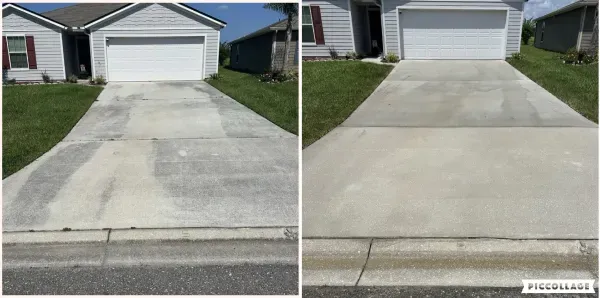
Pressure Washing in Durbin Crossing: Why Newer Homes Show Growth First
Durbin Crossing homes generally need a house wash every 12 to 18 months and a driveway cleaning every 12, because light-colored stucco and siding show algae long before darker finishes do, and the neighborhood's paver driveways, walkways and lanais hold moisture in their joints. Newer construction does not mean slower growth.
Why a newer neighborhood shows dirt sooner
Durbin Crossing was built with the palette that St. Johns County builders favored through the 2000s and 2010s: light stucco, white and pale gray siding, bright trim, and a lot of concrete paver hardscape. That palette looks sharp on move-in day and it is unforgiving after that. Green algae on a white wall reads as a stain at a distance. The same growth on a dark brick house is close to invisible until it is much worse.
Grading plays a part too. Newer communities are graded tight, lots sit close together, and irrigation runs on a schedule whether or not the yard needs it. Sprinkler heads that throw onto the wall put water on stucco several times a week, and that band of consistently damp finish about two feet off the ground is where the first green usually appears. Adjusting a head is often the cheapest exterior maintenance a homeowner can do.
Young landscaping cuts both ways. Durbin Crossing has less mature canopy than older parts of the county, so roofs and walls dry out faster after rain, which helps. But open lots also mean more direct sun on the north-facing shade line and more windblown dust and pollen landing on surfaces that nothing shelters. Homes here tend to get uniformly dusty rather than deeply shaded and stained.
Pay attention to the north side regardless. Every house in Florida has one elevation that never gets direct sun, and that wall dries slowest and grows first. On a light-colored Durbin Crossing home the north face will usually be visibly greener than the other three long before anybody decides the house needs washing. Walking that side once a season is the simplest way to know where you stand.
Pavers are the real maintenance item
Paver driveways, walkways, pool decks and lanais are everywhere in this neighborhood, and they behave nothing like a poured concrete slab. Every joint between pavers holds sand, and sand holds water. That gives moss, weeds and algae a place to root that a solid slab does not offer. A paver driveway that never gets cleaned will usually green up along the joints first and then spread across the faces.
Cleaning pavers is also more delicate than most people expect. Too much pressure blasts the joint sand out, leaves the pavers loose, and invites more weeds than you started with. Done correctly, the surface is cleaned at a controlled pressure and the joints are re-sanded afterward. If your driveway has already gone green, why Florida driveways turn green explains what is actually growing.
Sealing is a fair question in Durbin Crossing specifically, because so many homes have large paver areas and owners want the color back. Sealer does help joints stay put and makes future cleanings easier, but it has to go on a properly cleaned and dry surface or it locks the problem in. We lay out the honest tradeoffs in is paver sealing worth it.
Poured concrete in the neighborhood has its own pattern. Sidewalks and garage aprons pick up tire marks, rust from irrigation water, and the gray-green film that shows up wherever a downspout dumps. Concrete tolerates more pressure than pavers do, so the two surfaces on the same property are often cleaned differently, and a company that treats them identically is usually being rough on one of them.
HOA expectations in a newer community
Newer neighborhoods tend to enforce appearance standards more actively than older ones, and Durbin Crossing is no exception. The letters homeowners receive usually mention the same three things: a driveway with visible green or black staining, roof streaking, and mildew on the house itself. None of those are structural problems. All of them are visible from the street, which is the standard most associations actually apply.
Getting ahead of it costs less than reacting to it. A house that is washed on a schedule never reaches the stage where an association notices, and cleaning lightly soiled surfaces is faster and gentler than stripping heavy growth off later. If a letter has already arrived, our guide to handling an HOA letter about your driveway or roof covers what to do and how quickly.
Roof streaking deserves its own mention here because Durbin Crossing homes are now at the age where it starts. Shingle roofs installed 10 to 15 years ago commonly show black streaks on the north-facing slope first. That growth is treatable at low pressure, and treating it early keeps it from spreading across the whole plane.
Ask your association what its actual standard is before you assume. Some communities in St. Johns County send notices based on a scheduled drive-through, others only act on neighbor complaints, and the difference decides whether you should be on a fixed schedule or simply keeping an eye on things. Either way, a quick photo of your driveway next to your neighbor's tells you most of what you need to know.
What a sensible schedule looks like here
For most Durbin Crossing homes, a full house soft wash every 12 to 18 months and a driveway and walkway cleaning every 12 months keeps everything ahead of the curve. Houses with heavy tree cover on one side, or with sprinklers hitting the wall, should plan on the shorter end. Homes on open lots with well-aimed irrigation often stretch further.
Bundle the work when you can. Pavers, house, gutters and screens all get done more efficiently in one visit than in four, and the whole exterior ends up on the same clock instead of drifting. Nocatee homeowners face nearly the same conditions and the same materials, which we cover in pressure washing in Nocatee.
H2O Pressure Washing works throughout Durbin Crossing, Julington Creek, Fruit Cove, Nocatee and the rest of St. Johns County, and we will tell you plainly if something can wait another season. To get a straight answer on your home, Request a quote or call (904) 506-7656.
Frequently asked questions
My house is only a few years old. Does it really need washing yet?
Usually yes. Florida humidity grows algae on new stucco and siding just as readily as on old, and light colors show it early. Most newer St. Johns County homes look noticeably better after their first wash at the two year mark.
Will cleaning my paver driveway wash out the joint sand?
It can if the pressure is too high or the technique is careless. Done properly, the pavers are cleaned at a controlled pressure and the joints are re-sanded afterward so the surface stays locked and stable.
How fast do I need to respond to an HOA letter about my driveway?
Most associations give a window of a few weeks. Scheduling the cleaning and letting them know a date is on the calendar generally resolves it. Waiting until the deadline passes is what turns a notice into a fine.
Related reading
- What to Clean After a Hurricane in Florida, and in What Order
- Pollen Season in North Florida: When to Wash So It Actually Stays Clean
Get a free quote
H2O Pressure Washing serves Saint Johns and the wider St. Johns County area. For a free, fixed-price quote, tell us about your property or call (904) 506-7656.
