What to Clean After a Hurricane in Florida, and in What Order
After a hurricane, photograph everything before you clean, then work top down: clear gutters and roof debris, rinse salt spray off windows, screens and siding within a week, and wash driveways and decks last. Organic debris and salt that sit for weeks drive stains into concrete and finishes that later cleaning cannot fully remove.
Document first, clean second
Before anyone touches a hose, take photographs. Wide shots of each elevation, close shots of anything damaged, and a few of the debris where it landed. Date-stamped phone photos are fine. If you end up filing a claim, an adjuster is going to ask what the property looked like right after the storm, and a clean house with no record is a harder conversation than a dirty one with a hundred photos.
Keep the documentation going as you clean. Photograph the gutters before you empty them, the roof debris before it comes off, and any staining before it is washed away. We are not insurance people and we will not tell you what a policy will or will not cover, but we have watched enough claims go sideways to say this plainly: nobody has ever regretted taking too many pictures.
Separate the two jobs in your head. Storm repair is one thing and storm cleanup is another, and they run on different clocks. Repairs wait on adjusters, contractors and materials. Cleanup should not wait on anything, because the damage cleaning prevents is happening right now while the debris sits.
Write down what you find as you go, too. A short note listing which gutters were packed, where debris landed, what was already loose and what looked fine turns a folder of photos into something a person can follow months later. Keep receipts for any cleanup work in the same place. Whether any of it matters to a claim is between you and your carrier, but having it costs you nothing.
Why waiting turns storm dirt into permanent stains
Wet leaves, pine straw, oak tannin and mulch that get plastered against concrete by storm wind start leaching within days. Tannin is the brown stain a pile of wet leaves leaves behind on a driveway, and it soaks into the pores of the concrete rather than sitting on top. Cleaned in the first week or two it usually comes out. Left for a season, it often does not come out completely.
Salt behaves the same way on a different timeline. A hurricane pushes salt spray many miles inland, well past the beach communities, and that salt lands on windows, screens, lanai frames, light fixtures and painted surfaces across Jacksonville and St. Johns County alike. It holds moisture, it accelerates corrosion on metal hardware, and it feeds the growth that shows up as a green or black film a few months later.
Roof debris is the item with the shortest fuse. Branches, shingles granules and packed leaves that sit in a valley or against a chimney hold water directly against the roof deck, and organic debris left on shingles is a reliable way to seed the black streaking we cover in what causes black streaks on a roof. Clearing debris is not cosmetic. It is roof maintenance.
Flooding adds a category of its own. If storm surge or standing water reached a garage, a lanai or a low patio, the mud left behind carries whatever was in the water, and it sets hard on concrete as it dries. Surfaces that took floodwater should be cleaned and sanitized rather than simply rinsed, and they should be near the front of the list rather than the back.
The order that actually works
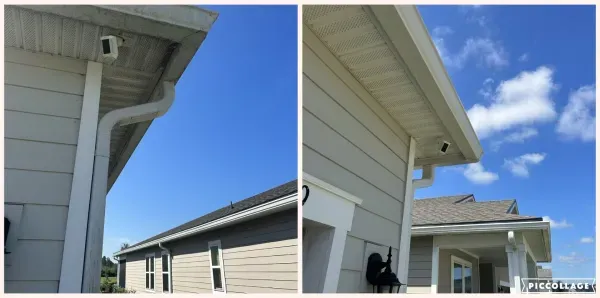
Start with gutters and downspouts. A storm fills them with leaves, twigs and roof grit, and a blocked gutter backs water up under the drip edge and over the fascia during the next rain, which in Florida is usually tomorrow. This is the single highest-value item on the list and it is why gutter cleaning frequency in Florida is worth reading before the next season.
Move to the roof and the upper surfaces next, then rinse the house. Salt and grime should come off siding, stucco, windows and screens before you touch the ground surfaces, because everything you clean up high runs down onto everything below. Screens and pool cages usually need a gentle rinse rather than a scrub, since storm debris often bends frames and loosens splines that heavy pressure will finish off.
Finish with driveways, walkways, pool decks and fences. Those are the surfaces where tannin and mud actually sit, and cleaning them last means you only do them once. Wood decks and fences that took wind-driven debris need a gentler approach than concrete, which we go through in cleaning wood decks and fences.
Expect the schedule to slip after a major storm, and plan for it. Every exterior company in Northeast Florida is booked solid for weeks after a hurricane, so the homeowners who get handled first are the ones who called while the wind was still dying down. Getting on a list early does not cost anything, and it beats waiting a month with wet leaves welded to the driveway.
The safety part, which matters more after a storm
Do not climb on a roof after a hurricane. A wet roof is slick, storm-loosened shingles move under your weight, and a decked area you walked on safely last month may be soft now. Add a ladder on saturated ground and you have the setup for the most common serious injury in exterior work. If something is on your roof, it can be reached from a ladder at the edge or handled by someone with the right equipment.
Watch for downed lines and hidden hazards in the yard before you start dragging hoses. Standing water can conceal debris, broken irrigation heads and, occasionally, live electrical. Utility crews are stretched thin after a major storm, so assume any drooping line is energized and stay well away from it until someone in a bucket truck says otherwise.
Roof cleaning after a storm should be done at low pressure regardless of who does it, because high pressure on storm-stressed shingles strips granules and can void coverage. The reasoning is in roof soft washing and your shingle warranty. If your home in St. Johns County or Northeast Florida took a storm and you want the cleanup handled in the right order, Request a quote or call (904) 506-7656.
Frequently asked questions
How soon after a hurricane should I clean my house?
Within a week or two if you safely can. Salt spray and wet organic debris do most of their staining in the first several weeks. Photograph everything before you start, in case you file a claim.
Does salt spray reach homes that are not near the beach?
Yes. A hurricane can carry salt spray many miles inland, so homes in Jacksonville, Fruit Cove and Fleming Island often get a salt film even though they are nowhere near the ocean. Windows and screens usually show it first.
Is it safe to get on my roof to clear branches after a storm?
It is not worth the risk. Wet shingles are slippery, storm-loosened material shifts under your weight, and ladders on saturated ground move. Debris can generally be cleared from a ladder at the edge or by a crew with proper equipment.
Related reading
- Pollen Season in North Florida: When to Wash So It Actually Stays Clean
- Pressure Washing in RiverTown: What River Air Does to a House
Get a free quote
H2O Pressure Washing serves Saint Johns and the wider St. Johns County area. For a free, fixed-price quote, tell us about your property or call (904) 506-7656.
