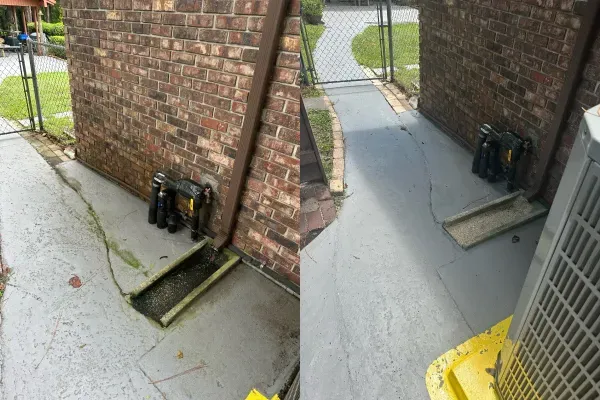
White Residue on Pavers: What Efflorescence Is and How to Deal With It
The white, powdery haze on pavers, concrete or brick is usually efflorescence: natural salts carried up from inside the material by moisture and left behind when the water evaporates. It is cosmetic, common on new pavers, and often fades on its own. When it does not, it needs a cleaner made for efflorescence, and it must be removed before any sealer goes on.
What efflorescence is
Concrete pavers, poured concrete, mortar and brick all contain small amounts of salts that dissolve in water. When water moves through the material, it carries those salts toward the surface. The water evaporates, the salts stay behind, and you get a white, chalky film. Left on the surface, some of it reacts with the air and hardens into a crust that is harder to remove.
Northeast Florida gives it plenty of water to work with. Summer storms, daily irrigation and a base that stays damp keep moisture moving up through pavers for much of the year. That is why a patio or driveway can bloom white after the rainy season even when nothing about it has changed.
It is most common on new pavers, often appearing in the first months after they are laid, but it can show up at any age where water keeps moving through the surface.
Watch where it gathers. Heavy bloom right beside a downspout, along the low edge of a patio, or where sprinklers hit every morning tells you exactly where water is soaking in. The same thing happens on brick walls and planters, usually starting at the base where the masonry stays wettest, and on the mortar joints of brick steps.
How to tell it apart from other white stains
Efflorescence is white or grayish, dry and powdery to the touch, and often patchy. A simple test: wet a spot with water. Efflorescence usually darkens and nearly disappears while wet, then comes back as it dries.
Other white marks look similar but need different fixes. A milky or cloudy haze on sealed pavers is often the sealer itself, when moisture gets trapped under it. A film left on the faces of the pavers after polymeric joint sand was installed is sand residue. White spots and rings where sprinklers hit are usually mineral deposits from the water, a close cousin of the orange iron stains covered in removing sprinkler rust stains.
A green or black film is not efflorescence at all. That is algae, and it is dealt with very differently, as explained in why Florida driveways turn green.
Why washing can make it worse, and what works
Pressure washing removes loose surface salt, so it looks like it worked. But the water soaks into the pavers, dissolves more salts inside them, and carries a fresh batch to the surface as it dries. It is common to wash efflorescence off and find it back, just as white, a few dry days later.
On new pavers, patience is often the best first step. Dry brushing and time let the bloom work itself out as the pavers settle. Where it persists or has hardened, a cleaner made specifically for efflorescence is applied, given time to work, scrubbed, and rinsed thoroughly so no cleaner is left in the joints. The pavers are then allowed to dry fully.
Avoid pouring strong acid on pavers yourself. It can etch the surface, fade colored pavers unevenly and attack the joint sand. Any cleaner should be tested on a hidden area first, and joints may need topping up with sand after cleaning.
Efflorescence and sealing
This is where it matters most. Sealing over efflorescence traps the white haze under the sealer, and the only real fix after that is stripping the sealer off and starting again. So efflorescence has to be removed, and the pavers fully dry, before any sealer goes on. That is also why many installers recommend a waiting period after new pavers are laid before they are sealed.
Once pavers are clean and sealed, the sealer slows the movement of water through the surface, which reduces future efflorescence, though it cannot stop moisture coming up from below entirely. The full order of operations is in why paver sealing is worth it in Northeast Florida, and poured driveways are covered in concrete sealing for a Florida driveway.
H2O Pressure Washing is certified in paver sealing. If you have white residue on pavers, concrete or brick and want to know what it is and what it will take, request a quote or call (904) 506-7656.
Frequently asked questions
Does efflorescence mean my pavers are defective?
No. It is a natural result of water moving through cement-based and clay products, and it is common on new pavers from every manufacturer. It is a cosmetic issue, not a sign of failure.
Will efflorescence go away on its own?
On new pavers it often fades over several months as the pavers weather. If it keeps coming back heavily, water is moving through the area constantly, and it is worth checking drainage and irrigation.
Can I seal over efflorescence?
No. Sealer locks it in and leaves a white haze under the surface. It has to be cleaned off and the pavers allowed to dry fully before sealing.
Does efflorescence damage pavers?
Usually not. It is mainly cosmetic. Heavy, repeated bloom in one area can point to a drainage problem worth fixing, though.
Related reading
Get a free quote
H2O Pressure Washing is based in Saint Johns and serves St. Johns County and nearby communities in Clay and Duval counties. For a free, fixed-price quote, tell us about your property or call (904) 506-7656.
