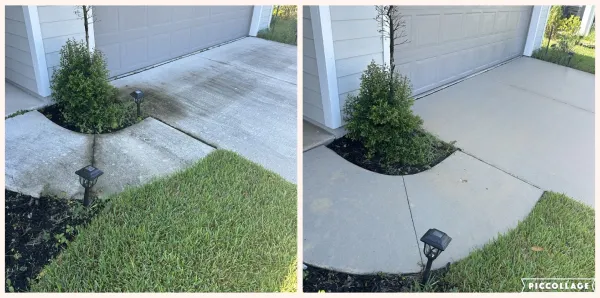
Acorn and Leaf Stains on Concrete: Fall's Brown Spots, Explained
Brown leaf outlines, dark acorn dots and tea-colored patches on a driveway are tannin stains. Wet leaves, acorns and pine needles leach natural tannins into porous concrete, a lot like a tea bag in water. They usually come out with the right cleaner and a gentle rinse rather than more force, and they are easiest to remove while they are fresh.
Why fall brings them
North Florida has two big debris seasons, and fall is one of them. Oaks drop their acorns from late summer into winter, pines shed a heavy layer of needles, and trees like sweetgum and maple let go of their leaves. Live oaks do their main leaf drop later, in late winter and spring, which is why some driveways get stained twice a year.
Fall also brings damp mornings. Once the first cool fronts arrive, heavy dew sits on concrete well into the day, and leaves and acorns that land on a damp driveway stay wet long enough to bleed. Add tires rolling over acorns and crushing them into the surface, and you get the dark dots that show up all over a driveway under an oak.
The worst spots are predictable: under a canopy, where a downspout dumps leaf-filled water, along the edge of a bed, and anywhere debris piles up against a curb or step and sits through a rain.
What a tannin stain actually is
Tannins are natural compounds in leaves, bark, acorns and needles. They are the same family of compounds that color tea, and they dissolve in water. Concrete is porous, so when wet debris sits on it, the colored water soaks into the surface and stays there after the leaf is gone. That is why you get a perfect brown silhouette of a leaf.
It helps to know what you are looking at, because each stain needs a different fix. A green or black film that gets slippery when wet is algae, which we cover in why Florida driveways turn green. Orange streaks and spots are usually rust from irrigation water. Dark, greasy patches under where a car parks are oil, and removing oil stains is a different job again.
Tannin stains are brown, tan or amber, often shaped like the debris that made them, and they are not slippery. Light concrete and light pavers show them most.
Pool decks and patios under trees collect them too, and they are often more noticeable there because those surfaces are lighter and people look at them up close. Stamped or painted concrete and travertine need extra care, because a cleaner strong enough for a plain gray driveway can dull a coating or etch soft stone. If you are not sure what your surface is, find out before trying anything stronger than water on it.
Why pressure alone will not lift them
The stain is inside the pores of the concrete, not sitting on top. Blasting it with a narrow pressure washer tip wears away the surface around it, which leaves wand marks and a rougher finish while the stain is still visible underneath. A lot of striped, patchy driveways got that way from someone chasing leaf stains with too much pressure.
What works is chemistry first. A cleaner made for organic staining is applied and given time to break the stain down, then the surface is cleaned with a flat surface cleaner at controlled, even pressure and rinsed. Heavy or old stains sometimes need a second application. Light stains often fade on their own in strong sun over a few weeks.
Timing matters too. Cleaning in the middle of the acorn drop means cleaning twice. The better plan is to keep debris swept off during the season and schedule the real cleaning once most of it has come down.
Keeping the next batch from setting
Blow or sweep the driveway and walkways once a week while things are falling, and always after a rain. Debris that is removed within a day or two rarely leaves a mark. Keep gutters clear so downspouts are not pouring leaf-stained water across the drive.
Sealing helps. A sealed surface absorbs far less, so tannins sit on top where they rinse away instead of soaking in. The pros and cons are laid out in whether concrete sealing is worth it for a Florida driveway.
If your driveway is already covered in brown spots, request a quote or call (904) 506-7656. We will tell you honestly which stains should come out and which may only lighten.
Frequently asked questions
Will leaf stains fade on their own?
Light, recent ones often fade in direct sun over a few weeks. Heavy stains, stains in shade, and spots that get re-stained every season usually need cleaning to go away.
Can I use bleach on tannin stains?
A diluted chlorine-based cleaner often lightens organic stains, but it can also burn grass and plants at the edges, so wet those down first and rinse well afterwards. Never mix cleaners, especially chlorine with acids or ammonia.
Do sealed pavers get leaf stains?
Much less often. Sealer slows absorption, so debris has time to be swept or rinsed away before it leaves a mark. It is not a force field, though, and piles left through a rain can still stain.
When is the best time to clean up fall stains?
After most of the acorns and needles have come down, usually late fall or early winter. Cleaning in the middle of the drop means the driveway is stained again within weeks. Keep it swept until then so new stains do not set.
Related reading
Get a free quote
H2O Pressure Washing is based in Saint Johns and serves St. Johns County and nearby communities in Clay and Duval counties. For a free, fixed-price quote, tell us about your property or call (904) 506-7656.
