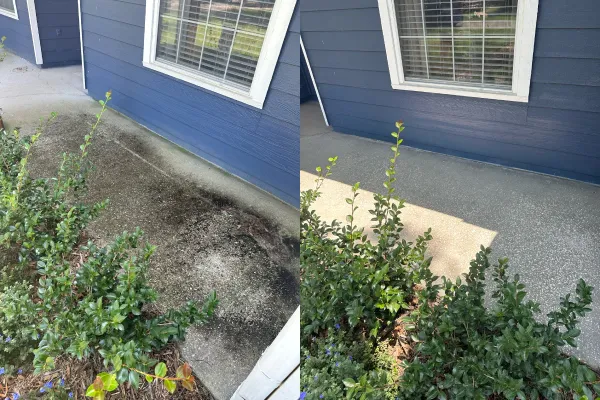
Why Is the Bottom of My House Dirty After It Rains?
The dirty band along the bottom of a house is usually splashback. Heavy rain hits bare soil, mulch or sand next to the foundation and throws it up onto the lower wall, and that damp, dirty strip then grows algae and mildew. A house wash cleans it off, and changing what sits right against the wall keeps it from coming back as quickly.
How splashback happens
Northeast Florida summer storms drop a lot of water in a short time. When those big drops land on bare dirt or loose mulch, they kick up soil and fine debris. Anything within a foot or two of the wall gets thrown onto the siding, stucco or block. The roof makes it worse: if there are no gutters, or a gutter overflows, a sheet of water pours off the eave and hits the ground in a line along the house, digging a small trench and splashing hard.
Homes in Penney Farms and the rest of rural Clay County often sit on sandy soil with wide planting beds or bare ground near the foundation, which gives storms plenty to throw. Red clay and dark pine mulch leave the most obvious stains.
Why the stain turns green or black
Splashback does not just leave dirt. It leaves organic material on a surface that stays damp longer than the rest of the wall, since it is close to the ground and often shaded by shrubs. That is ideal for algae and mildew. Within a season the brown band can turn green or gray black, and on stucco and painted block it can start to look like a permanent stain.
If the lower wall stays wet for a long time, check irrigation too. Sprinklers aimed at beds against the house add moisture every day and often leave orange rust marks from well water. The post on sprinkler rust stains on concrete and siding explains how to tell the difference.
How to clean it off
A garden hose and brush can move some loose dirt, but it rarely touches the growth that has settled in. A proper house wash uses low pressure with a cleaning solution that kills algae and mildew, then rinses the soil out of the surface texture. This matters most on stucco and textured block, where high pressure can damage the finish and drive dirt deeper.
Concrete walkways and pads that run along the house usually have the same staining and are worth doing at the same time so the whole base of the house looks even. Our exterior cleaning services cover full house washing and walkways, and our concrete cleaning services handle pads and patios.
How to stop it coming back so fast
Cover bare soil next to the foundation. River rock or gravel in the first foot or so along the wall splashes far less than dirt or light mulch, and it drains well. If you prefer mulch, use a heavier, shredded type and keep it a few inches below the bottom of the siding.
Manage the roof water. Clean gutters that do not overflow, and downspouts that carry water away from the wall, stop the sheet of runoff that causes the worst splash. Our guide on how often to clean gutters in Florida covers timing.
Trim shrubs back from the wall so the lower siding gets air and sun and dries faster after storms. Point sprinklers away from the house so the base is not wet every morning.
When to wash the base of your house
Late summer and early fall, after the heaviest storm months, is a good time to clean up splashback before it settles in further. If you only notice it in one area, it is still usually worth washing the whole wall so the cleaned strip does not stand out against the rest of the house.
Frequently asked questions
What is the dirt on the bottom of my siding?
It is usually soil, sand or mulch splashed up by rain, often with algae and mildew growing in the damp band afterward.
Can I just hose it off?
A hose can remove loose dirt, but algae and mildew in the texture usually need a cleaning solution and a proper rinse to come off evenly.
What should I put next to my foundation to stop splashback?
Rock or gravel in the first foot along the wall splashes far less than bare soil or light mulch, and it drains well.
Do gutters help with dirt on the lower wall?
Yes. Gutters that flow properly stop the sheet of roof runoff that hits the ground beside the house and causes the worst splash.
Who cleans dirty siding in Penney Farms, FL?
H2O Pressure Washing cleans splashback, algae and mildew off homes in Penney Farms and across Clay County. Call (904) 506-7656 for a free quote.
Get a free estimate in Penney Farms, FL
H2O Pressure Washing is a family-owned pressure and soft washing company based in St. Johns, FL, serving St. Johns County, Jacksonville and Clay County. Call (904) 506-7656, see the service, or request a free quote. More answers on the H2O blog.