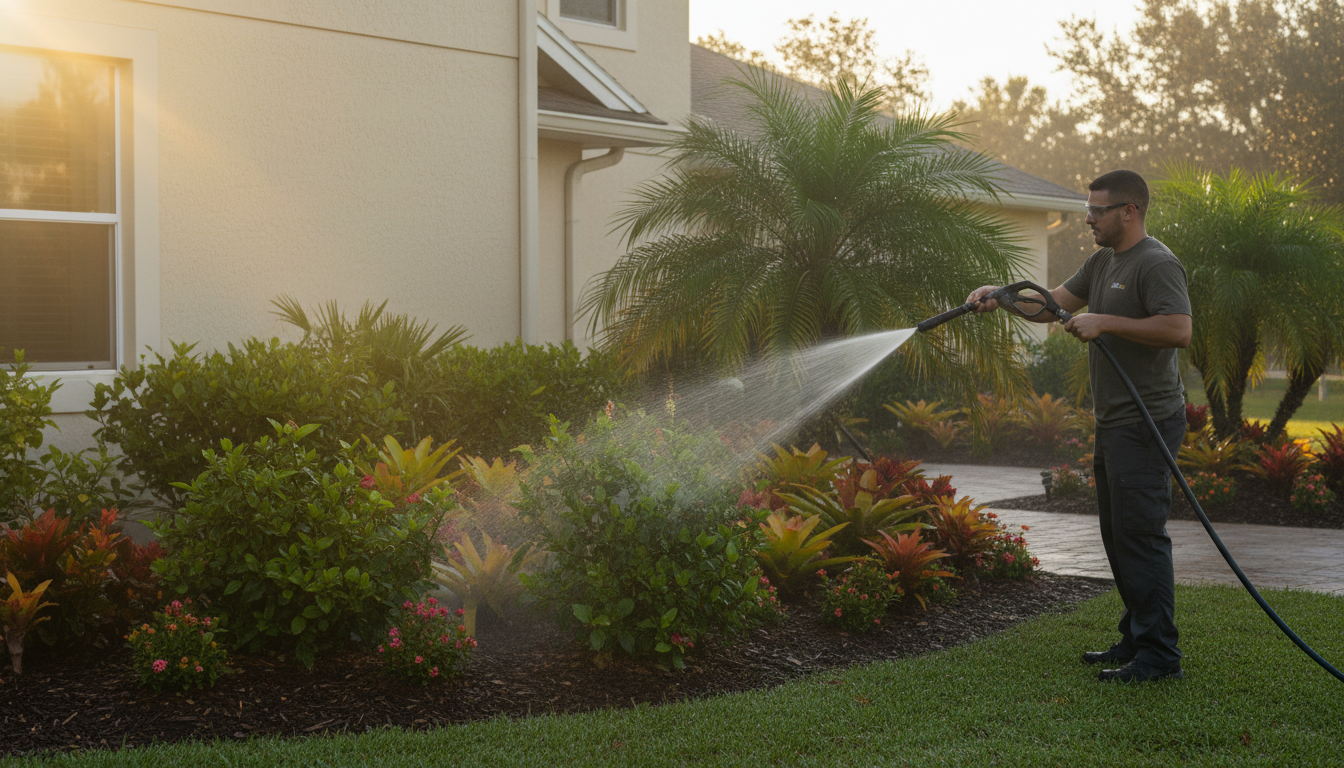
What Is Actually In a Soft Wash Mix, and How We Protect Your Landscaping
People ask this more than any other question, usually phrased as whether it will kill the plants. It is a fair question and it deserves a straight answer rather than the word eco friendly.
What is in it
A soft wash mix for exterior cleaning is normally three things. Water, which is most of it. Sodium hypochlorite, which is the same active ingredient as household bleach, heavily diluted. And a surfactant, which makes it cling to a vertical wall long enough to work and helps it rinse off cleanly.
The point of the hypochlorite is that algae, mildew and lichen are living organisms. You are not scrubbing them off, you are killing them so they release and rinse away. That is why a soft wash stays clean longer than a pressure wash. Blasting growth off leaves the roots behind, and it grows back from them.
The dilution is the whole thing
A house wash mix is weak. Far weaker than what you would pour into a washing machine. It is strong enough to kill surface growth on a wall and no stronger, because the finish has to survive it too.
Concrete and paver work runs stronger, because the growth sits down in the pores rather than on a finish. That is exactly why hard surface work needs more water on the surrounding planting, not less.
How we protect the plants
Dilution is the first defense, and water is the second.
- Everything gets soaked before we start. A plant full of clean water cannot take up much of anything else. This is the single most effective step and it is the one that gets skipped when someone is rushing.
- We keep soaking during the work on hot days, because evaporation concentrates whatever lands.
- Everything gets rinsed after. Beds, lawn, hardscape.
- Sensitive planting gets covered where it needs it, though wet is usually better than covered, since a covered plant bakes.
What can still go wrong
Being honest about this is more useful than a guarantee. Plants already stressed by drought are more vulnerable, which is why we water first. Very new planting that has not rooted is more fragile. And a few things, delicate ferns and some flowering annuals right at the drip line, can show leaf tip burn even when everything is done properly. It is cosmetic and it grows out.
In ten years of doing this across St. Johns County, plant damage is rare and it is nearly always about preparation rather than the mix.
Ask any contractor two questions
What is in the mix, and do you pre wet the landscaping. If either answer is vague, keep calling.
We are happy to walk you through exactly what we are putting on your house before we start.
