How Florida Humidity Grows Algae on Your Home
Everything green, grey or black on the outside of your Florida house is alive. Understanding what feeds it is most of the battle.
The three things growth needs
Moisture, shade and a surface porous enough to hold on to. Northeast Florida supplies all three for most of the year, which is why exterior growth here is a maintenance item rather than an occasional surprise.
Our humidity rarely drops low enough, for long enough, to dry surfaces out completely. Afternoon storms wet everything down again. Mild winters mean growth never gets the hard reset that a freeze delivers further north.
Why some surfaces go first
Concrete and pavers
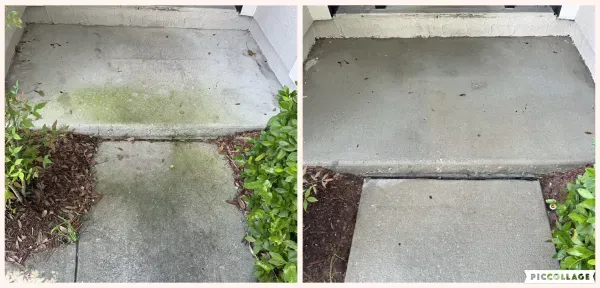
Concrete looks solid but its surface is full of microscopic pits that trap water and organic debris. That makes it one of the first things to turn green. It is also the one that becomes genuinely slippery, which matters on walkways and pool decks.
North facing walls
Less sun, slower drying, more growth. This is why one elevation of a house so often looks years older than the others.
Roofs
Asphalt shingles contain limestone filler, and the algae that causes black roof streaks feeds on it directly. The roof is not just a passive surface, it is food.
Soffits and eaves
Air barely moves under an eave, so moisture lingers. Soffits collect a dark film that most homeowners never look up at until it is pointed out.
Why rinsing never works for long
A hose removes the layer you can see and leaves everything rooted in the pores of the surface. That is why a rinsed driveway looks better for a fortnight and then goes green again, often faster than before, because you have removed the competition and left the roots.
Proper exterior cleaning applies a cleaning solution, gives it time to kill growth at the root, then rinses. The difference is months versus a year or more.
Free quotes across St. Johns, St. Augustine, Fruit Cove and the surrounding areas. Call (904) 506-7656.
Pressure is not the answer to everything
Concrete tolerates a flat surface machine well. Siding, stucco, soffits and roofs do not. Those need soft washing, where the cleaning is done by solution rather than force. Using high pressure on them drives water into places it should never go and can damage the surface permanently.
Slowing it down
- Point sprinkler heads at the lawn, not the house or the concrete
- Open up permanent shade where you reasonably can
- Clear leaves and organic debris rather than letting them break down in place
- Clean on a schedule rather than waiting for growth to become obvious
You will not beat a Florida climate. You will make each cleaning last considerably longer.
- Moisture, shade and porous surfaces are what growth needs, and Florida supplies all three.
- Concrete, north walls, roofs and soffits are the first to show it.
- Rinsing removes what you can see and leaves the roots behind.
- Concrete tolerates pressure. Siding, stucco and roofs need soft washing.
Frequently asked questions
Why does the growth come back so quickly after I hose it off?
Because rinsing removes only the visible layer. What is rooted in the pores of the surface survives and regrows, often faster than before.
Is exterior algae harmful to my family?
It is mainly a surface and appearance issue. The real safety concern is that algae on wet concrete is slippery, particularly on walkways and pool decks.
How long should a professional clean last?
Around a year for most Northeast Florida homes. Heavily shaded properties and those near water regrow sooner.
Can I prevent it entirely?
Not in this climate. You can slow it noticeably by fixing irrigation overspray, reducing permanent shade and clearing debris.
Does the same method work on every surface?
No, and that is the most common mistake. Concrete, siding, stucco and roofs each need different pressure and different chemistry.
Free quotes across St. Johns, Clay and Duval counties. Call (904) 506-7656 or request a quote online.
